
What Is a Coronectomy? A Complete Guide to This Wisdom Tooth-Saving Procedure


If your dentist told you that your wisdom tooth is very close to a nerve, you might hear a new word: coronectomy. That word can sound scary at first. But don’t worry. It is actually a safe and smart option in many risky wisdom tooth cases.
In this guide, you’ll learn what is a coronectomy, why it is done, how it works, how painful it is, how long recovery takes, and how it compares to extraction. Everything is explained in very simple words.
What Is a Coronectomy?
A coronectomy is a dental condition where only the top part (crown) of a tooth is removed, and the roots are left inside the jaw on purpose.
This is done mainly for lower wisdom teeth that sit too close to a major nerve in your jaw. That nerve controls feeling in your lip, chin, and jaw. If that nerve gets damaged, you may feel numb for a long time.
So instead of pulling the whole tooth out, the dentist removes only the risky part and leaves the roots behind safely.
How Is a Coronectomy Performed?
Many people ask, How is a coronectomy performed? The good news is that the process is simple, safe, and usually quick. It is done step by step with great care to protect the nerve.

1. X-ray or CBCT Scan
Before the surgery starts, the dentist takes a special X-ray or a 3D scan called a CBCT. This scan shows how close the wisdom tooth roots are to the nerve. This step is very important because it helps the dentist decide if a coronectomy is the safest choice for you.
2. Numbing the Area with Local Anesthesia
Next, the dentist gives local anesthesia. This medicine makes your gums, jaw, and tooth area completely numb. You will be awake, but you will not feel pain. You may only feel a little pressure.
3. Small Opening in the Gum
Once the area is numb, the dentist makes a small opening in the gum to reach the tooth. This opening is just big enough to safely work on the tooth. The dentist is very careful to protect the nearby bone and nerve.
4. The Crown of the Tooth Is Cut and Removed
Now the dentist carefully cuts the crown (top part) of the wisdom tooth. Only this top part is removed. This is the main step of a coronectomy. The crown is taken out piece by piece, so nothing touches the nerve.
5. The Roots Are Left Safely Inside the Bone
After the crown is removed, the roots are left behind inside the jawbone on purpose. These roots are not loose, and they are not infected. Leaving them inside keeps the nerve safe and avoids permanent numbness.
6. The Area Is Cleaned and Stitched
Once everything is done, the dentist cleans the area to remove any debris. Then a few stitches are placed to close the gum. These stitches may dissolve on their own or be removed later.
7. Total Time of the Procedure
The full coronectomy procedure usually takes 30 to 45 minutes. After that, you can go home the same day and start your recovery.
This careful step-by-step method is what makes coronectomy a safe and nerve-protecting wisdom tooth procedure.
Is a Coronectomy Safe?
Yes, coronectomy is safe provided that it is performed on the right patient and for the right reason. Not all people are recommended this procedure by dentists. It is applied in cases where a normal tooth extraction may harm a significant nerve in the jaw.
This nerve regulates sensation in your lower lip, chin, and jaw. When it is hurt, the numbness may take months or even become permanent. A coronectomy helps protect this nerve, which is why it is chosen in high-risk cases.
Many medical studies show that coronectomy greatly reduces the chance of nerve damage when compared to full wisdom tooth extraction in risky situations. That is the biggest safety benefit of this procedure.
When Is Coronectomy Considered Safe?
A coronectomy is considered safe when all of the following conditions are met:
- The tooth is not infected
If there is an active infection, leaving roots inside can trap bacteria. - The roots are not loose.
Loose roots can move easily and cause future problems. - The tooth is alive (not dead)
A dead tooth has a higher risk of infection after surgery. - There is no large cyst or tumor around the tooth.
Cysts and tumors must be fully removed, which requires full extraction.
When all these conditions are met, coronectomy becomes a very safe and smart choice. The tooth must not be infected before a coronectomy is done. If you have any gum problems or signs of infection, it’s important to address them before surgery.
Why Dentists Recommend It Only in Special Cases
Dentists recommend coronectomy only when:
- The tooth is touching or wrapping around the nerve
- The risk of permanent numbness is too high with extraction
- Keeping the nerve safe is the top priority
Therefore, when your dentist recommends a coronectomy, it does not imply that your case is not good. It just implies that your dentist is making the safest possible choice in the long-term comfort and nerve health of you.
Concisely, coronectomy is safe; research has shown it is safe, and many oral surgeons have confidence in it when performed in the right patient.
Is a Coronectomy More Painful Than Extraction?
A very common fear many patients have is, is a coronectomy more painful than extraction.
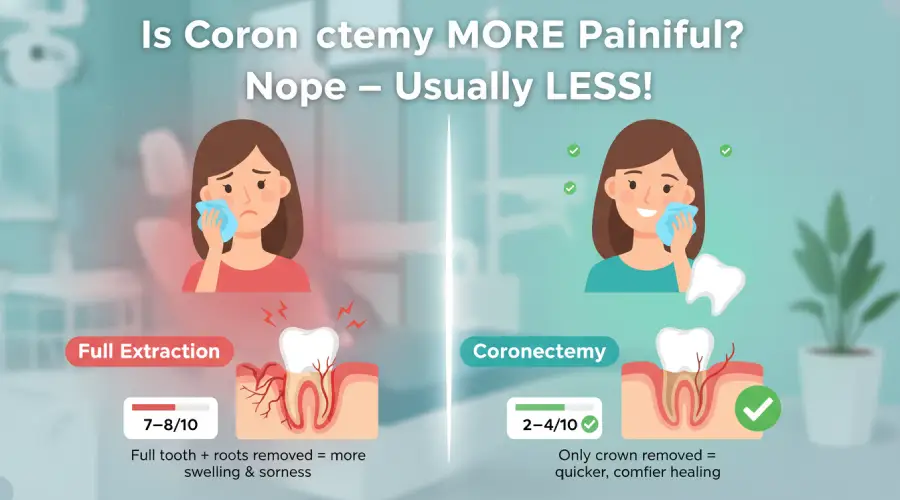
The easy and comforting response is no. The pain is the same or even less than a complete wisdom tooth removal in most cases. The reason is that a coronectomy is a less invasive surgery in which the crown of the tooth is extracted and not the whole tooth.
The roots remain in the same position, so the adjacent nerve is not irritated, preventing acute nerve pain and chronic numbness. Since fewer bones and tissues are involved, the process of healing can be much easier and more comfortable in many patients.
Following the operation, you might experience slight pain, slight swelling, and slight jaw stiffness, which is common with any dental operation. These symptoms are mostly short-lived and can be treated with basic treatment. The prescribed pain medicine, ice packs to reduce swelling, and good rest are the common methods of controlling pain.
The majority of them resume normal comfort in a few days. Actually, most of the patients report that a coronectomy is very similar to a normal tooth extraction and is even easier than a complete extraction.
Coronectomy Recovery Time | What to Expect
Healing after a coronectomy is usually smooth and comfortable for most people. Because only the crown of the tooth is removed and the roots are left safely inside the bone, the body often recovers with less stress compared to a full extraction. Still, proper care during recovery is very important for fast and safe healing.
Right After Surgery (First 24–48 Hours)
During the first one to two days, your body starts repairing the area. This is the most sensitive stage of healing.
- Mild pain and swelling are normal
- Rest is very important
- Eat only soft foods like soup, yogurt, or mashed food
- Avoid hot, spicy, and hard food
- Use ice packs on the cheek to reduce swelling
- Take medicines exactly as prescribed by your dentist
These steps help control pain, reduce swelling, and protect the surgical area.
First Week After Coronectomy
As the days pass, your mouth will slowly start to feel more normal. Most people feel much better by the end of the first week.
- The swelling slowly starts to go down
- Pain becomes less each day
- Stitches may dissolve on their own or be removed by the dentist
- You can return to light daily work
- Avoid heavy exercise and hard chewing
This is the stage when most patients feel confident moving around and doing basic activities again.
After 2 to 4 Weeks
By this time, the gum tissue is mostly healed, and daily comfort improves a lot.
- The gum is mostly healed
- You can start eating normal food again
- The surgery area feels comfortable
- Daily routine becomes fully normal
At this stage, most people no longer feel that they even had surgery.
Long-Term Healing
Even after the gum heals, slow internal healing continues inside the bone.
- The roots left behind may slowly move deeper into the bone
- This movement is normal and usually causes no pain
- Follow-up X-rays may be taken to check healing
- The second surgery is rarely needed
Your dentist will monitor this during regular check-ups.
Total Recovery Time
Overall, recovery from a coronectomy is faster than many people expect.
- Most people feel fully comfortable within 7 to 10 days
- Complete internal healing continues slowly over time
- Long-term results are usually very successful
With proper care and follow-up, most patients heal without any problems. To maintain the best results after a coronectomy, it is important to practice preventive dental habits.
Coronectomy Complications and Risks
A coronectomy is a relatively safe procedure, though severe complications are rare. A majority of the patients recover without significant problems.
Infection, dry socket, swelling, pain, or slight movement of the roots that have been left in the bone are some of the potential risks. In uncommon situations, a second procedure might be required due to the occurrence of problems.
One should look out for the warning signs, which include extreme pain, fever, bad odor in the mouth, pus, or excessive swelling. Whenever any of these take place, contact your dentist.
Most patients recover well with proper treatment and follow-up, and complications can be treated easily. Most risks are prevented by preventive measures such as good oral hygiene and adhering to post-operative instructions.
Coronectomy vs Extraction: Which Is Better?
Many patients ask about coronectomy vs extraction. The answer depends on nerve risk.
Feature | Coronectomy | Full Extraction |
Nerve Damage Risk | Very Low | High in risky cases |
Tooth Part Removed | Crown only | Full tooth |
Recovery | Smooth | Can be difficult |
Second Surgery | Rare | Usually not needed |
Best For | High-risk nerve cases | Normal cases |
Will the Roots Left Behind Cause Problems Later?
The question that most people fear is the roots that are left behind following a coronectomy. The best news is that in most instances, these roots remain silent in the bone, and they do not bring any pain. With time, the bone gradually develops over them, ensuring that they remain in place. This is a natural process that normally eliminates the development of any problems.
In other cases, the roots can gradually creep upwards in months or years. When they approach the surface of the gums, the dentist may be required to extract them to avoid pain or infection. This occurs in a very few patients, however.
Even in the case that the roots move slightly, it hardly leads to significant issues. The majority of the population does not suspect anything when they go on with their daily activities. Dental check-ups and X-rays are taken regularly to check the roots and make sure that they are healthy.
Simply put, abandoning the roots is not very dangerous. The body gets used to it, and when these roots are taken care of, they do not normally cause any problem to your teeth, gums, or jaw. Patients will be assured that this process aims at safeguarding their nerves and oral health over time.
Conclusion
What Is a Coronectomy? A coronectomy is a safe and effective dental procedure used to remove only the crown of a wisdom tooth while leaving the roots in place. This approach is especially helpful when full extraction carries a high risk of nerve injury. Most patients experience mild pain, smooth healing, and minimal coronectomy complications. The roots left behind usually stay quietly in the bone, and long-term results are very positive.
If your dentist recommends a coronectomy, it is because your safety and oral health are the priority. Following proper care, understanding the coronectomy recovery time, and attending follow-up visits will help ensure smooth healing and the best outcome. Remember, oral health is connected to your overall health, so staying consistent with checkups is essential. With this procedure, you can protect your nerves while treating your wisdom teeth safely.
Care at 65 Broadway Dental
At 65 Broadway Dental, we explain what a coronectomy is and how it can save your wisdom tooth. We break down the procedure in simple words, so you know what to expect and feel comfortable. Our goal is to protect your teeth while keeping your smile healthy.
FAQs
1. Is a Coronectomy Permanent?
Yes, in most cases, the roots left behind after a coronectomy stay safely in the bone for life. They rarely cause problems and usually do not need further treatment.
2. Can a Coronectomy Fail?
Coronectomy failure is very rare. It may happen if an infection develops or if the roots move unusually, but most procedures are successful.
3. Is Coronectomy Safe Long-Term?
Yes, coronectomy is considered safe for the long term. Studies show that most patients experience minimal complications and excellent results over time.
4. Is a Coronectomy Painful?
Pain after a coronectomy is usually mild and comparable to a normal tooth extraction. Swelling and discomfort are temporary and manageable with pain medicine and care.
5. How Long Is Coronectomy Recovery?
Most people recover fully within 7 to 10 days. Swelling and mild soreness improve quickly, and normal eating and daily activities can resume soon.

Dr. Alexander Heifitz (Author)
Dr. Alexander Heifitz is the founder of 65 Broadway Dental in NYC, where he combines advanced dental expertise with a patient-first approach. He specializes in cosmetic and restorative treatments such as dental implants, veneers, Invisalign, and smile makeovers, helping New Yorkers achieve both oral health and confidence.

Booking An Appointment
Looking for a reliable dentist in Downtown NYC? Whether you need a routine cleaning, urgent care, or a full smile transformation — we’ve got you covered. We accept most PPO insurance plans and offer flexible scheduling.
+1 (212) 430-3888
Call for appointment
Walk-ins Welcome / Same-Day Appointments Available

Related Blogs
Dental Crown Procedure: Step-by-Step, What to Expect
Understand the dental crown procedure step by step, including preparation, temporary crowns, placement, and care for a strong tooth.
Read More
When Do You Need a Dental Crown? 7 Signs It’s Time
Same-Day Dental Crowns Explained: How CEREC Technology Creates Strong, Natural-Looking Crowns in Just One Visit Without Waiting Weeks
Read More